



When I tell people I’ve been writing since before I could write, folks tend to look at me like I’ve lost my mind.
Just a friendly reminder: two things can be true at once, y’all.
Some of my earliest memories are of my paternal grandmother acting as my secretary and ghostwriter as I crafted fan letters to people I admired and/or to people who inspired me.
I would tell Granny what I wanted to say, and she would turn my four-year-old gibberish into something that could actually be put on paper and mailed to another human being.
Looking back, I realize she wasn’t just helping me write letters. She was teaching me that words could connect me to people I had never met. They could turn an idea in my head into something another person could see, understand, and maybe even feel. They could make a stranger feel a little less strange.
By the time I actually learned to write, I didn’t think about it much. Writing was simply something I did. Writer was already becoming a part of my identity.
Granny gave me something more important than lessons in spelling, grammar, or sentence structure. She gave me permission.
Permission to play with words. To ask questions. To make connections. To tell stories. To say the things I was thinking and feeling, even when I wasn’t entirely sure what those things were yet.
And even when I wasn’t sharing my work publicly, I was usually writing privately. I filled notebooks and journals, wrote letters I sometimes sent and sometimes didn’t, scribbled down thoughts and observations, and kept returning to the page whenever I needed to make sense of something. Writing became a place where I could say whatever I wanted without worrying about whether anyone else would read it, understand it, or approve of it.
Sometimes I was trying to tell a story. Sometimes I was trying to figure out how I felt about something. Sometimes I was simply getting the noise out of my head and onto paper.
I didn’t always think of that as being a writer. I just knew that when I had something to say, writing was one of the ways I made sense of it. Looking back, though, I realize the distinction between writing for an audience and writing for myself was never really that important. Either way, I was practicing the same thing: paying attention to my life and trying to find the words for what I saw, felt, remembered, and imagined.
I’ve always loved words, including the ridiculous number of ways a few letters can be rearranged to mean completely different things.
Take write and right.
One is an act of putting words on a page. The other can mean correct, moral, proper, or simply the opposite of left.
And yet, when I think about why I write, those two words feel pretty connected.
Writing helps me figure out what I think is right.
Not necessarily right in the universal, objective, capital-T Truth sense. I’m not claiming that my blog posts contain the answers to life or anything of the sort. Lord knows they don’t.
But writing does help me work things out. It gives shape to all those vague thoughts rattling around in my head. It lets me examine memories from different angles. It helps me connect seemingly unrelated dots. Sometimes I sit down thinking I know what I want to say and discover, several hundred words later, that I was actually trying to say something completely different.
That’s part of the magic.
Writing isn’t always about knowing what you want to say before you start. Sometimes writing is how you find out what you have to say.
I’ve spent a lot of my life trying to make sense of myself, other people, the world around me, and the batshit circumstances we all find ourselves navigating.
Writing has become one of the ways I do that. When something is bothering me, I write about it. When something delights me, I write about it. When I don’t understand something, I write about it until I understand it a little better.
And when I encounter something that makes me laugh, cry, angry, curious, nostalgic, horny, hopeful, or some combination of all of the above, there’s a pretty good chance I’ll eventually write about it. Publicly and/or privately.
That’s probably why I’ve never been particularly interested in writing that feels overly polished or precious.
I like writing that sounds like somebody is actually talking to me.
I like the little imperfections. The asides. The parenthetical thoughts. The unexpected detours. The sentence that takes a sharp left turn because the writer suddenly remembered something important.
In other words, I like writing that feels alive.
That doesn’t mean craft doesn’t matter. The more I write, the more I appreciate the craft behind making words sound effortless. And over the years, I’ve found plenty of authors and teachers between the covers of books.
A few of the books about writing that have influenced me, inspired me, or simply made me think differently about the work include:
On Writing by Stephen King
Part memoir, part craft book, and part kick in the ass, King makes writing feel less like some mystical gift bestowed upon a chosen few and more like something you get better at by doing.Bird by Bird by Anne Lamott
A comforting reminder that sometimes the only way to tackle something enormous is to focus on the tiny piece directly in front of you.Writing Down the Bones by Natalie Goldberg
A reminder that writing can be a practice rather than a performance. Write. Pay attention. Keep going.Steering the Craft by Ursula K. Le Guin
Le Guin approaches writing as something you can experiment with. Rhythm, point of view, sentence length, sound, perspective: writing becomes play, and play is where some of the best discoveries happen.Screenplay: Foundations Of Screenwriting by Syd Fied
I bought and read this screenwriting classic when I was 14, and it became one of the books that shaped my early understanding of storytelling. Twelve years later, when I was 26, I had the honor and pleasure of meeting Syd. I eventually became his webmaster and worked with him for more than a decade. Over the years, we cussed and discussed the art and craft of screenwriting and filmmaking more times than I can count. I’m beyond grateful to have had Syd as a friend, client, and mentor.
These books have taught me different things, but they’ve all reinforced something I learned from Granny before I was old enough to understand it: writing isn’t really about having all the answers. It’s about being curious enough to ask the questions.
Because these days, so much of what I write is about my own life. And writing about your own life can be a strange business.
There’s a temptation to think that because something happened to you, you automatically have a story. But an experience and a story aren’t necessarily the same thing. The experience is what happened. The story is what you make of it.
Writing helps me figure out the difference.
It helps me revisit things I thought I understood and discover that maybe I didn’t. It lets me look backward without necessarily getting stuck there. It gives me a way to take the random assortment of memories, mistakes, victories, disappointments, relationships, losses, obsessions, and ridiculous little moments that make up a life and see if I can find some kind of thread running through them.
Sometimes I find one. Sometimes I don’t. And that’s okay, too.
I’m still learning how to write. And I suspect I always will be.
There are things I understand now that I couldn’t have ten, twenty, or thirty years ago. There are things I thought I knew about storytelling that I’ve completely changed my mind about. There are sentences I would have written differently then. There are sentences I probably should have written differently yesterday.
And that…is okay.
The goal isn’t to become a perfect writer. The goal is to become a better one.
And maybe that’s another reason I’m grateful my grandmother became my very first writing partner. Because she didn’t worry about whether my letters were good. She didn’t tell me I was too young to have something worth saying. She simply listened to what I wanted to say and helped me put it into words.
Decades later, I’m still doing essentially the same thing. Only now I’m my own secretary. My own ghostwriter. My own editor. And my biggest critic.
I write because words help me understand the world.
I write because words help me understand myself.
I write because somewhere along the way, a little boy discovered that putting words together could create a connection between himself and somebody else.
And I write because my grandmother taught me, long before I was old enough to understand, that what I had to say was worth writing down.
She was right. Or maybe I should say she was write.
Either way, I’m still here. Still playing with words. Still making connections. Still trying to figure out what the hell I think. And still writing and righting.
Keep calm and write/right on!
Clint 🌈✌️
COLLIDE PRESS is a reader-supported publication.
Please consider becoming a Paid Subscriber or Patron.
HOT SUMMER OFFER
10% Off All Subscriptions (Forever)
Ends 08-31-26 @ 11:59pm
FROM THE ARCHIVES
NSFW MONTAGES = On Substack
SFW MONTAGES = On YouTube
BORN THIS WAY ON THIS DAY
08-14 = Guglielmo Plüschow (1852-1930) = German photographer 🌈

08-14 = Horst P. Horst (1906-1999) = German-American photographer 🌈
08-14 = Jill Bennett (1975- ) = American actor 🌈
08-14 = Mark Pocan (1964- ) = American politician 🌈
MAN CRUSH OF THE DAY
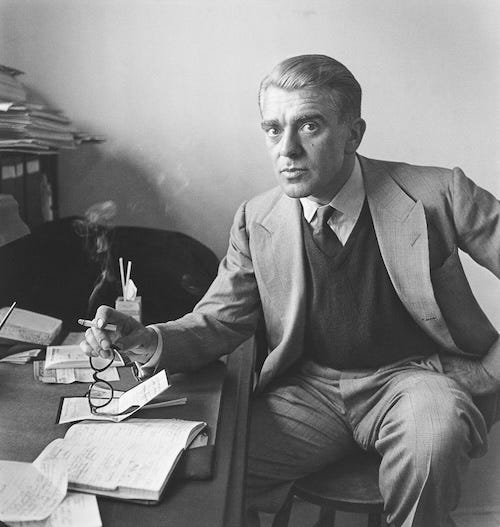
“I like taking photographs, because I like life. And I like photographing people best of all, because most of all I love humanity.”
Horst P. Horst
Clint,
On Writing by Stephen King, Bird by Bird by Anne Lamott and Writing Down the Bones by Natalie Goldberg inspirted me also. Great minds! Ours...
Fondly
Michael