


As a kid, I remember hearing Judy Garland sing “Over the Rainbow” and imagining a magical place where the problems of the world simply disappeared. A place where people could just be themselves. A place where we all belonged.
Of course, reality is rarely that simple.
Like many LGBTQ+ people, I’ve learned that belonging is less of a final destination and more of a lifelong search. We spend years looking for spaces where we can lower our guard, speak honestly, and exist without explanation or apology.
Maybe that’s why I think of that song whenever I think about Gilbert Baker. Not because he created a fantasy, but because he took something as ordinary and extraordinary as a rainbow and turned it into a symbol of belonging. In doing so, he helped generations of LGBTQ people find not only community, but pride in themselves.
What can I possibly say about Gilbert Baker that hasn’t already been said?
By now, most know the basics. He designed the rainbow flag. He gave our community a global symbol. His work has inspired generations and become one of the most recognizable images in modern history. The facts are easy to find. What’s harder to articulate is what that flag actually means to me.
Every Pride Month, I find myself trying to put it into words, and every year I come up a little short. I think about it whenever I see one hanging from a front porch or displayed in a storefront window. I think about it when politicians argue over it, and when corporations embrace it for thirty days before quietly packing it away.
For me, the rainbow flag has always meant something far more personal: the possibility of belonging in a world that doesn’t always make room for people like us.
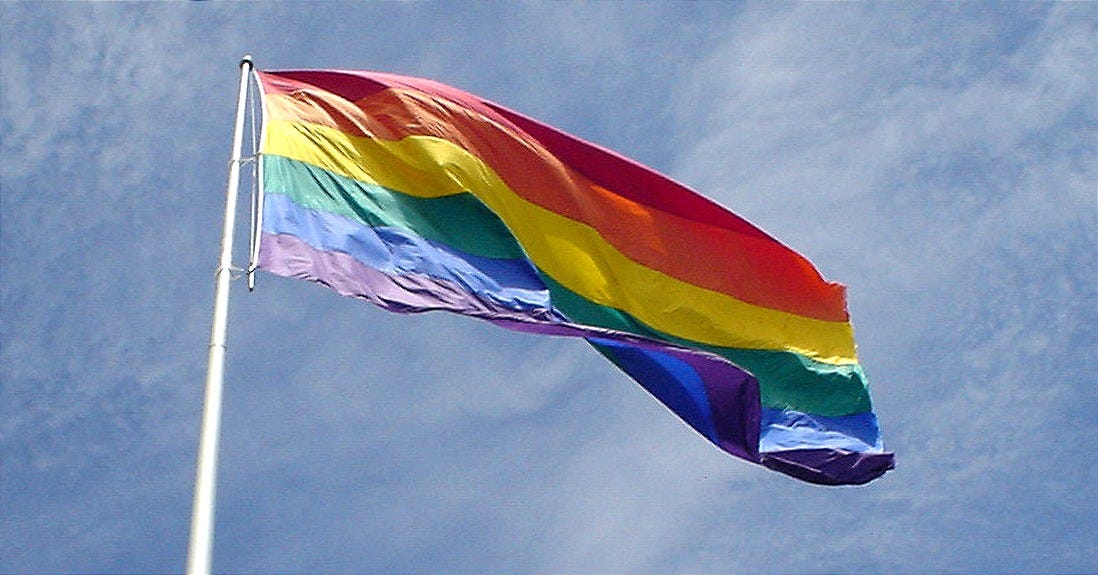
I especially think about it when I remember the first time I saw the giant rainbow flag flying over the Castro in San Francisco. Circa 2000.

At the time, I was still carrying around a lifetime of messages telling me I was different. That certain parts of myself were better left hidden and unspoken.
Like many LGBTQ+ people, I had become accustomed to scanning every room, every neighborhood, and every new situation for clues about whether I would be safe and accepted.
Then, I looked up and saw that enormous rainbow flag waving against the sky.
Something inside me broke open. It wasn’t just fabric. It was visibility. It was history. It was a soaring reminder that millions had walked this path before me, and millions would come after. For the first time in my life, I felt connected to something vastly larger than my own limited experience.
That is the genius of what Gilbert Baker created. Before the rainbow flag, many LGBTQ symbols were tied to tragedy, struggle, and persecution. They carried vital history, but they also carried deep pain.
Baker chose a different path. He chose a rainbow, a symbol of diversity and hope. That choice was more radical than it may seem today. For generations, LGBTQ people were taught to hide who they were, apologize for who they loved, or feel ashamed of their existence. Baker’s flag offered a different message: you belong, and there is beauty in being exactly who you are.
The older I get, the more remarkable Baker’s achievements seem. The LGBTQ community is not a monolith. We come from different backgrounds, cultures, and generations, often holding wildly different ideas about our collective future. And yet most of us embrace the rainbow flag (or a variation of it) wholeheartedly.
Most flags represent nations; they define borders and separate people into groups. Baker’s flag does the exact opposite. It invites people in. It says there is room here. It says you’re not alone.
I suspect that’s why it continues to resonate nearly fifty years after its creation.
For some, it is a political statement. For others, a celebration. For many, a battle cry.
I don’t know if Gilbert Baker could have fully predicted the impact his creation would have. I doubt anyone could.
On my first visit to San Francisco, a giant rainbow flag made me cry. I didn’t cry because I had finally arrived at that mythical place I imagined as a child. I cried because, for the very first time, I felt seen and part of something bigger.
Few people have given a greater gift to the LGBTQ community than the man who stitched together a handful of colored stripes and created a symbol that reminds us we are better together.
Somewhere over the rainbow, we’re told, dreams come true.
Gilbert Baker’s legacy is a timeless symbol of love and light.
Thank you, Mr. Gilbert!
Keep calm and get your Pride on…
Clint 🌈✌️
COLLIDE PRESS is a reader-supported publication.
Please consider becoming a Paid Subscriber or Patron.
FROM THE ARCHIVES
BORN THIS WAY ON THIS DAY
06-02 = Andy Cohen (1968- ) = American television host 🌈
06-02 = Brent Hawkes (1950- ) = Canadian pastor and activist 🌈
06-02 = Gilbert Baker (1951-2017) = American artist 🌈
06-02 = Marquis de Sade (1740-1814) = French aristocrat and politician 🌈
06-02 = Wayne Brady (1972- ) = American actor, comedian, host, and singer 🌈
06-02 = Wentworth Miller (1972- ) = American actor and screenwriter 🌈
06-02 = Zachary Quinto (1977- ) = American actor 🌈
MAN CRUSH OF THE DAY


“The rainbow is a part of nature, and you have to be in the right place to see it. It’s beautiful, all of the colors, even the colors you can’t see. That really fit us as a people because we are all of the colors. Our sexuality is all of the colors. We are all the genders, races, and ages.”
Gilbert Baker
👍5⭐ Cheers DougT🏴 🇬🇧
🌈🏳🌈