


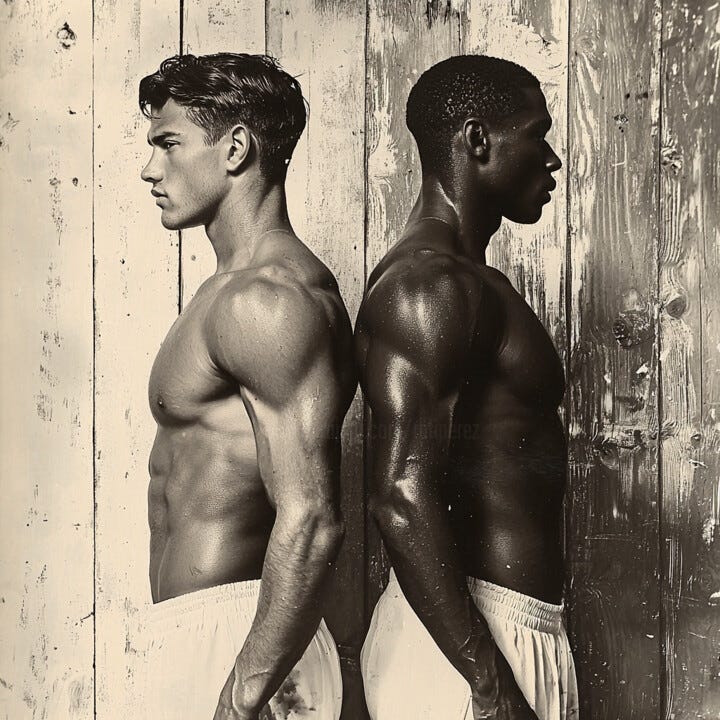
I’ve gotten several questions lately about whether and how I use AI in my montages. It’s a fair question. Because “authenticity” is getting easier and easier to fake these days, especially on the interwebs.
Back in 2024, I made a few montages using entirely AI-generated images. I labelled them as fauxtos. But quite a few folks didn’t read the title and assumed the images were real photographs. That’s when I realized I need to be more careful about what I put out into the world.
My passion is vintage photography, not AI.
But I’m not opposed to using technology. Modern AI tools make it possible to preserve and restore old photographs that might otherwise fade away forever.


I also like to “re-AImagine” contemporary and vintage photos as short videos.
But these uses are very different from generating images out of thin air.
I’m not here for deepfakes or any other kind of covert fuckery. If I’m using AI, I will always make sure to label it appropriately.
To the best of my knowledge, only a handful of images I’ve featured in montages have later turned out to be either AI-generated or heavily Photoshopped.

Unfortunately, it’s getting harder and harder for me to tell the difference. The AI image generators are incredibly powerful now. And unscrupulous users are trying to pass off AI fauxtos as the real thing.
So I do my best to stay vigilant. I look closely. I question things. I try to trace images back to their sources whenever possible. Because my goal is simple: I want the photos I share to be real photographs of real people.
Unless clearly labeled otherwise, my montages are made from actual photos.
There is one small technical wrinkle I should mention. Until recently, I occasionally used an upscaling feature in CapCut to improve the resolution of older, low-quality images. Sometimes the results looked so smooth and polished that people assumed the images were entirely AI-generated.
Because of that, I’ve stopped using the feature. If an image is low resolution, it will stay low resolution. I would rather keep the texture and imperfections of the digital scan than accidentally create confusion or doubt.
Old photos, and the sometimes low-resolution scans we have of them today, carry a certain honesty. Grain. Scratches. Imperfect lighting. A real moment in time, captured by a real camera, in a real place, of real people.
That’s the magic.
AI may imitate the look of photography. Sometimes it can even fool us. But imitation is not the same thing as history. And history is what interests me.
Keep calm and carry on!
Clint 🌈✌️
COLLIDE PRESS is a reader-supported publication.
Please consider becoming a Paid Subscriber or Patron.
FROM THE ARCHIVES
BORN THIS WAY ON THIS DAY
03-05 = Eva Kotchever (1891-1943) = Polish-Jewish librarian and writer 🌈
03-05 = Matt Lucas (1974) English actor, comedian, and tv personality 🌈
03-05 = Pier Paolo Pasolini (1922-1975) = Italian actor and filmmaker 🌈
03-05 = Sadao Hasegawa (1945-1999) = Japanese artist and activist 🌈
MAN CRUSH OF THE DAY
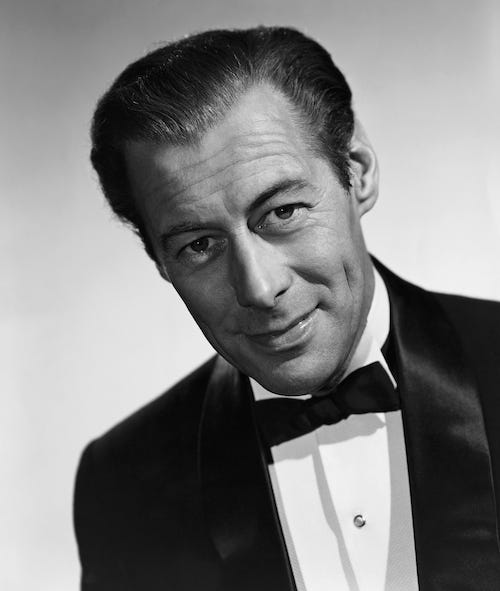
“I’m at the age where I’ve got to prove that I’m just as good as I never was.”
Rex Harrison
Love, love, love LITTLE BRITIAN! Thanks for being upfront and discussing AI in your work. Things are moving so quickly what if we do not discuss it, room for assumptions exponentially accelerate. Fondly, Michael
Heart, knowledge, and intuition. Even when you're fooled, as far as I'm concerned, you're not fooled. Something in the ones that fools you is authentic, if not what you're aiming for. Always enjoy your attempts to engage with these photos.